
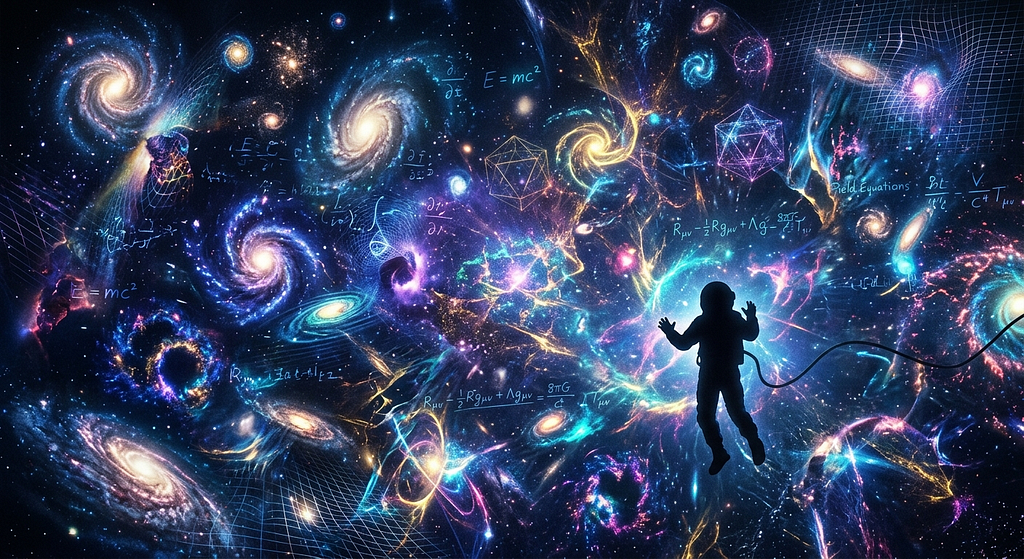
There is a question that science can approach — but never fully finish.
A question so simple that even a child can ask it…
yet so deep that the greatest minds in physics still hesitate.
Why does anything exist at all?
Not just stars, not just planets — but anything.
Space, time, matter, energy… even the laws that define them.
If the universe follows rules, then the biggest mystery is:
Who or what created the rules themselves?
We often imagine “nothing” as empty space.
No matter. No light. No energy.
But modern physics destroys this idea.
Even in “empty space,” particles appear and disappear constantly. Energy fluctuations never stop. The vacuum is not truly empty — it is alive in a strange mathematical way.
So the real question becomes:
If even nothing is not nothing…
then did true nothing ever exist?
Or is “nothing” just something we cannot observe properly?
The universe is not quiet.
It is constantly moving, expanding, evolving.
Galaxies drift apart. Stars are born and die. Black holes swallow entire systems.
But here is the paradox:
All of this follows mathematical laws.
Gravity, quantum mechanics, thermodynamics — everything behaves as if it is following a script.
So the question becomes dangerous:
If everything follows a script, where is the writer?
We experience time as a straight line:
Past → Present → Future
But physics disagrees.
According to relativity, time is not fixed. It changes depending on gravity and speed. Near a black hole, time slows down dramatically compared to Earth.
This means:
So we must ask:
If time changes depending on perspective…
then is time real, or just another illusion our brain agrees on?
Black holes are not just objects.
They are breakdown points of physics.
Inside a black hole, gravity becomes infinite. Space and time stop behaving normally. Even light cannot escape.
And the biggest problem is this:
We don’t fully know what happens inside.
Even Einstein’s equations stop working at the center (singularity).
So we reach a terrifying conclusion:
The universe has places where its own rules stop working.
If laws break down somewhere…
are they truly universal laws?
Physics says information cannot be destroyed.
But black holes seem to destroy everything that falls inside them.
So which one is correct?
Both cannot be true at the same time.
This is called the black hole information paradox.
And it leads to a deeper idea:
Maybe reality is incomplete.
Maybe our understanding is missing a key piece.
If the universe follows mathematical laws so precisely, some scientists ask:
What if reality is computational?
What if:
If that is true, then another paradox appears:
Who is running the simulation?
And if there is no simulation…
why does mathematics describe reality so perfectly?
Why does the universe behave like a system designed to be understood?
After all science, all equations, all discoveries…
We arrive at the same wall:
We can describe how the universe behaves…
but not why it exists in the first place.
So we are left with a final thought:
If everything follows rules…
then the greatest mystery is not the rules themselves —
but why rules exist at all.
The universe is not just a place.
It is a question that keeps asking itself through us.
Every human who thinks, observes, and wonders is part of that question.
And maybe the goal is not to find a final answer…
but to keep exploring a universe that refuses to be fully understood.
Get the latest updates and blog posts delivered straight to your inbox.