
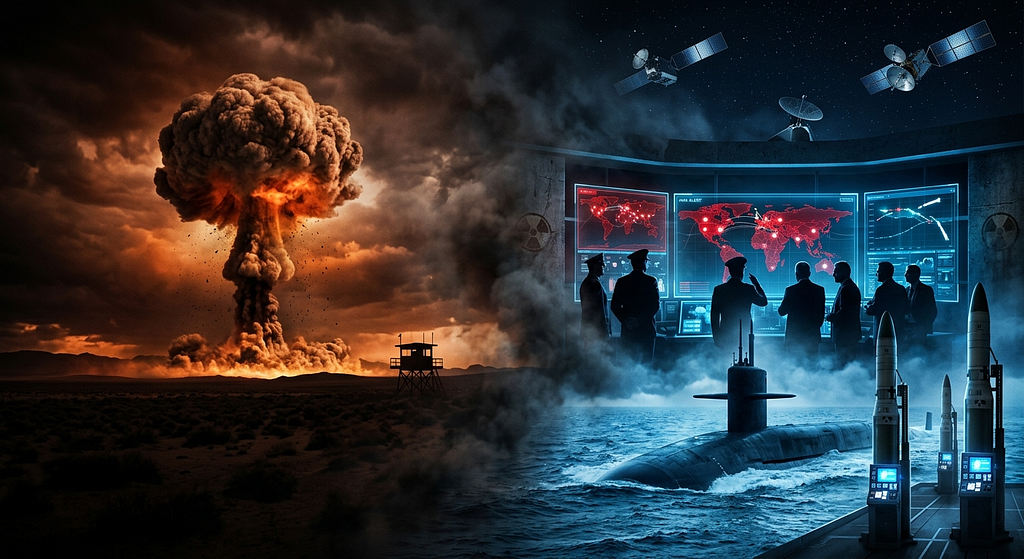
Humanity created many powerful inventions.
Electricity changed civilization.
The internet connected the world.
Artificial intelligence is reshaping the future.
But no invention ever terrified humanity more than the moment humans learned how to split the atom.
The nuclear age did not simply begin with science.
It began with fear.
In the early 20th century, scientists started exploring the hidden structure of matter.
Atoms — once believed to be indivisible — contained enormous amounts of energy.
Then came a terrifying realization:
If that energy could be released rapidly… the result would be catastrophic.
The equation that symbolized this era became famous worldwide:
E = mc²
This idea revealed that even a tiny amount of matter could produce unimaginable energy.
At first, it sounded like scientific progress.
Soon, it became a weapon race.
During World War II, global powers feared one thing above all:
What if their enemies built the bomb first?
This fear triggered one of the most secretive scientific projects in history: The Manhattan Project.
Scientists worked under extreme secrecy to create the first atomic weapon.
Then, in 1945, humanity crossed a line it could never uncross.
The first nuclear bomb exploded during the Trinity Test in the deserts of New Mexico.
For the first time in history, humans witnessed a weapon powerful enough to destroy entire cities in seconds.
The world changed forever.
Shortly after the test, two Japanese cities became symbols of the nuclear age:
The explosions instantly killed tens of thousands of people.
Entire neighborhoods disappeared beneath heat, fire, and shockwaves.
But the most horrifying effects continued long after the blast:
Humanity realized something terrifying:
Science had created a weapon capable of threatening civilization itself.
After World War II, the United States and the Soviet Union entered a new kind of conflict.
Not direct war.
A psychological war.
Both sides rapidly built larger and deadlier nuclear weapons.
This became known as the Nuclear Arms Race.
The logic was strange and terrifying:
“We must build more weapons so nobody dares to attack us.”
Fear became global policy.
The first atomic bombs were devastating.
But soon, countries developed something even worse:
Hydrogen bombs.
These weapons were hundreds of times more powerful than the bombs dropped during World War II.
Then came:
Humanity created systems capable of destroying the planet multiple times over.
In 1962, the world came dangerously close to nuclear war.
The Soviet Union placed nuclear missiles in Cuba, near the United States.
For days, global tension reached terrifying levels.
People feared the world could end within hours.
Governments prepared for possible nuclear attacks. Families feared annihilation.
One wrong decision could have triggered global catastrophe.
Fortunately, both sides stepped back before it was too late.
But the message was clear:
Human civilization was now permanently vulnerable.
Nuclear weapons created one of history’s strangest paradoxes.
They are built to prevent war… by threatening total destruction.
This idea became known as:
Mutually Assured Destruction (MAD).
The concept was horrifying:
Peace was maintained not through trust —
but through fear.
As global tensions evolved, more nations pursued nuclear capability.
Pakistan’s nuclear program became a major turning point in South Asian history.
Following regional conflicts and security concerns, Pakistan intensified its nuclear development efforts.
In 1998, Pakistan conducted nuclear tests, officially becoming a nuclear power.
For many Pakistanis, it represented:
But it also placed Pakistan inside one of the world’s most dangerous geopolitical realities: nuclear deterrence.
Today, nuclear weapons are no longer just giant bombs.
Modern systems involve:
The danger has evolved.
The fear remains.
One technological mistake, cyberattack, or political miscalculation could create consequences beyond imagination.
The nuclear race revealed something important about humanity.
Human intelligence advanced faster than human wisdom.
We gained the power to destroy civilization before fully learning how to control conflict.
That contradiction still exists today.
The same species capable of creating art, medicine, and scientific discovery also built weapons capable of ending millions of lives within minutes.
The nuclear race was never only about weapons.
It was about fear, power, survival, and human ambition.
And even today, decades later, the world still lives beneath invisible shadows created during that era.
Humanity unlocked the energy hidden inside atoms.
The real question is:
Did humanity unlock wisdom at the same speed?
Get the latest updates and blog posts delivered straight to your inbox.